LOOM
Micro-Scale Spatial Level Design, Objective-Driven Tension, and AI Predator Pacing
A PSX-style first-person survival game developed in Unity. The player takes the role of a tiny spider trapped inside a massive human house. The core design challenges revolved around architecting 3D vertical terrain from a micro perspective, pacing an objective-driven gameplay loop (building 4 strategic webs before time expires), and balancing an autonomous predator AI that threatens player progress through web destruction.
DESIGN OWNERSHIP NOTE: All level geometry, spatial metrics, objective pacing, predator state flow, and player mechanics were conceptualized, blockouted, and balanced by me. AI tooling was strictly utilized for C# syntax prototyping and shader optimization.
Level Schematic & Spatial Hierarchy
By analyzing the macro room layout and grayscale value composition, we examine how the environment guides player sightlines, communicates traversable 3D surfaces, and creates structural tension between predatory patrol routes and micro safe-harbors.
Level Schematic & Patrol Routing
Table Plateau
High-ground observation node & Web 02 anchor. Provides a complete 360-degree vantage point over the floor patrol vectors.
Exposed Carpet Chasm
High-risk predator patrol artery. An open floor transit corridor directly intersected by the enemy spider's primary sweep path.
Baseboard Crevices
Micro safe zones immune to predator collision. Narrow structural crevices where the larger enemy spider cannot enter.
Ceiling Corner Anchor
High-elevation climax & Web 04. Demands multi-surface climbing mastery across inverted wall angles under ticking countdown clock pressure.
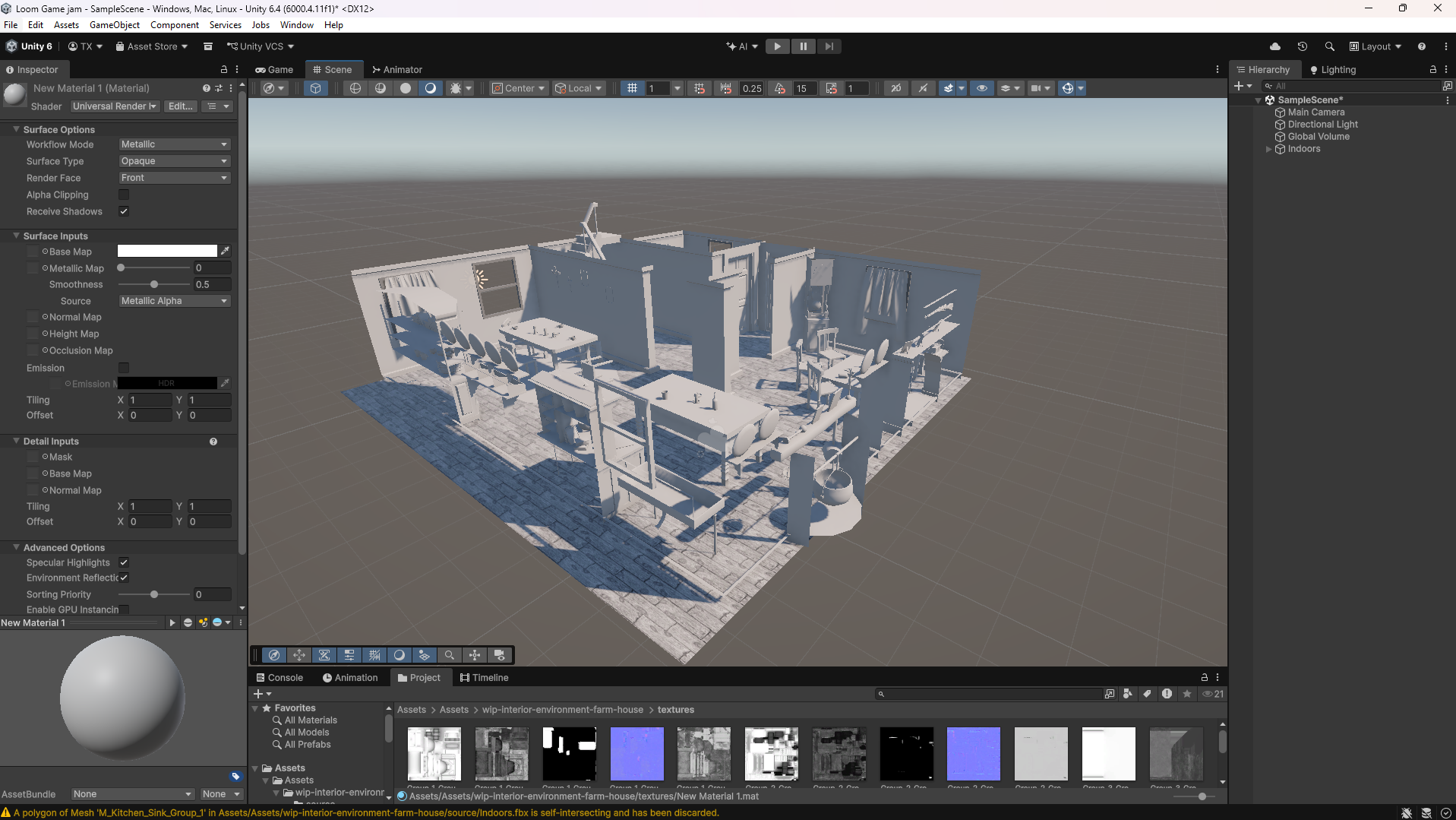
Plateau vs Chasm Spatial Hierarchy
The high table surface serves as a visual landmark and safe observation deck. Ground carpet areas are intentionally exposed, forcing the player to sprint across open sightlines or commit to vertical climbs along furniture legs.
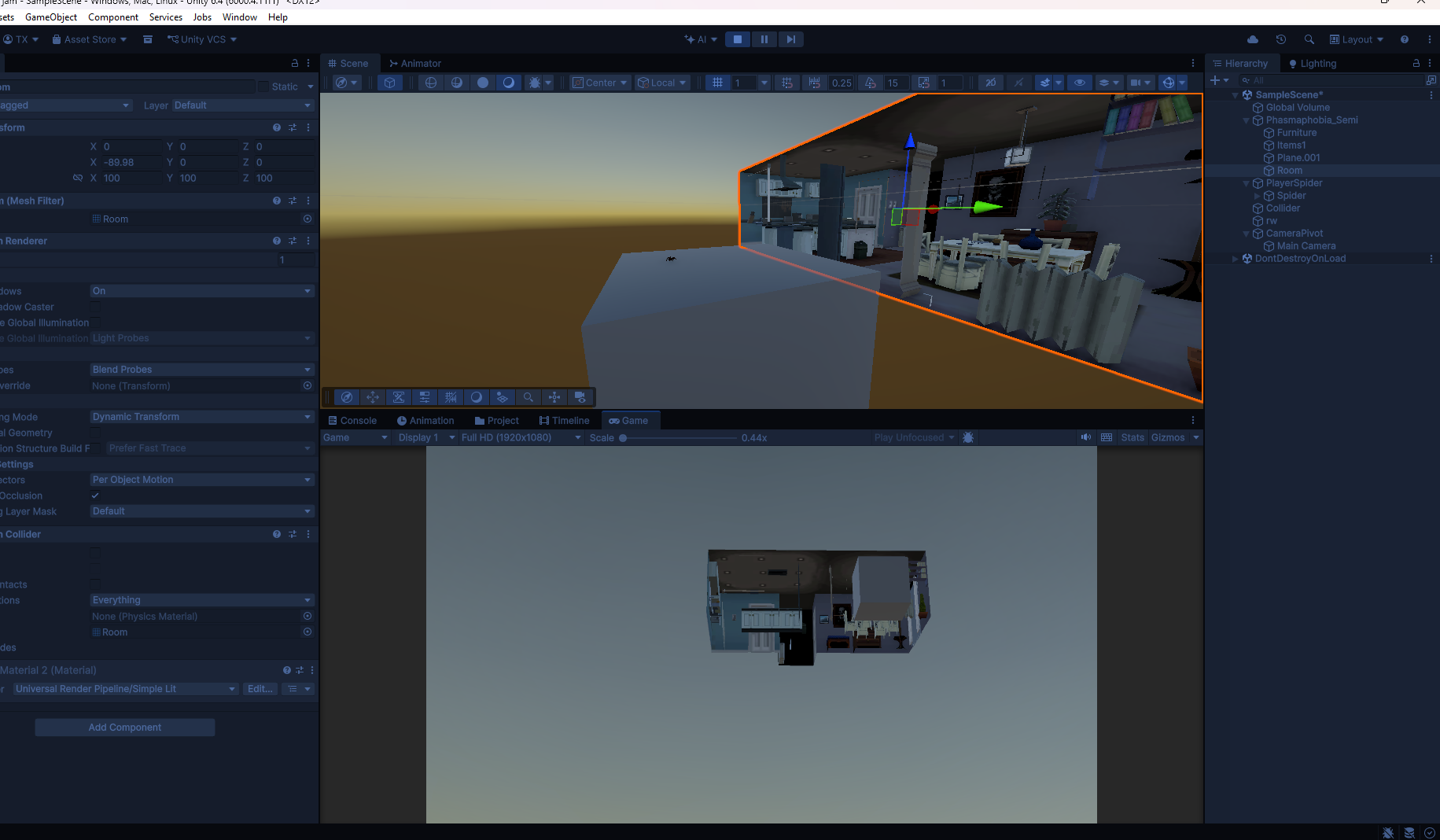
Vertical Transition & Occlusion Cover
This mid-elevation node bridges ground navigation and ceiling traversal. Wall seams provide continuous climbing rails while table corners occlude the player from ground-level AI sweeps.
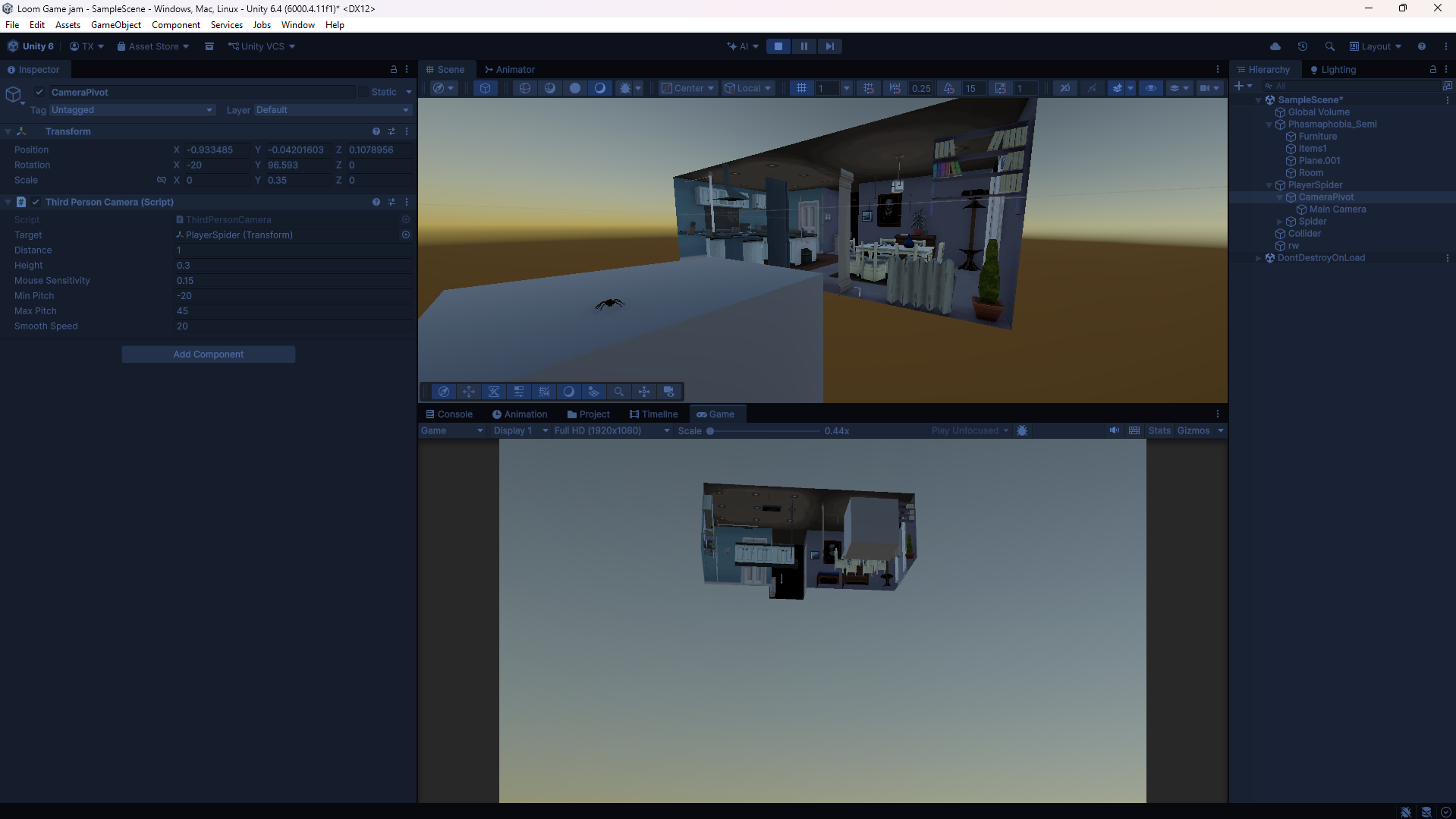
Enemy Patrol Intersection
Open intersection along the primary predator route requiring strict timing.
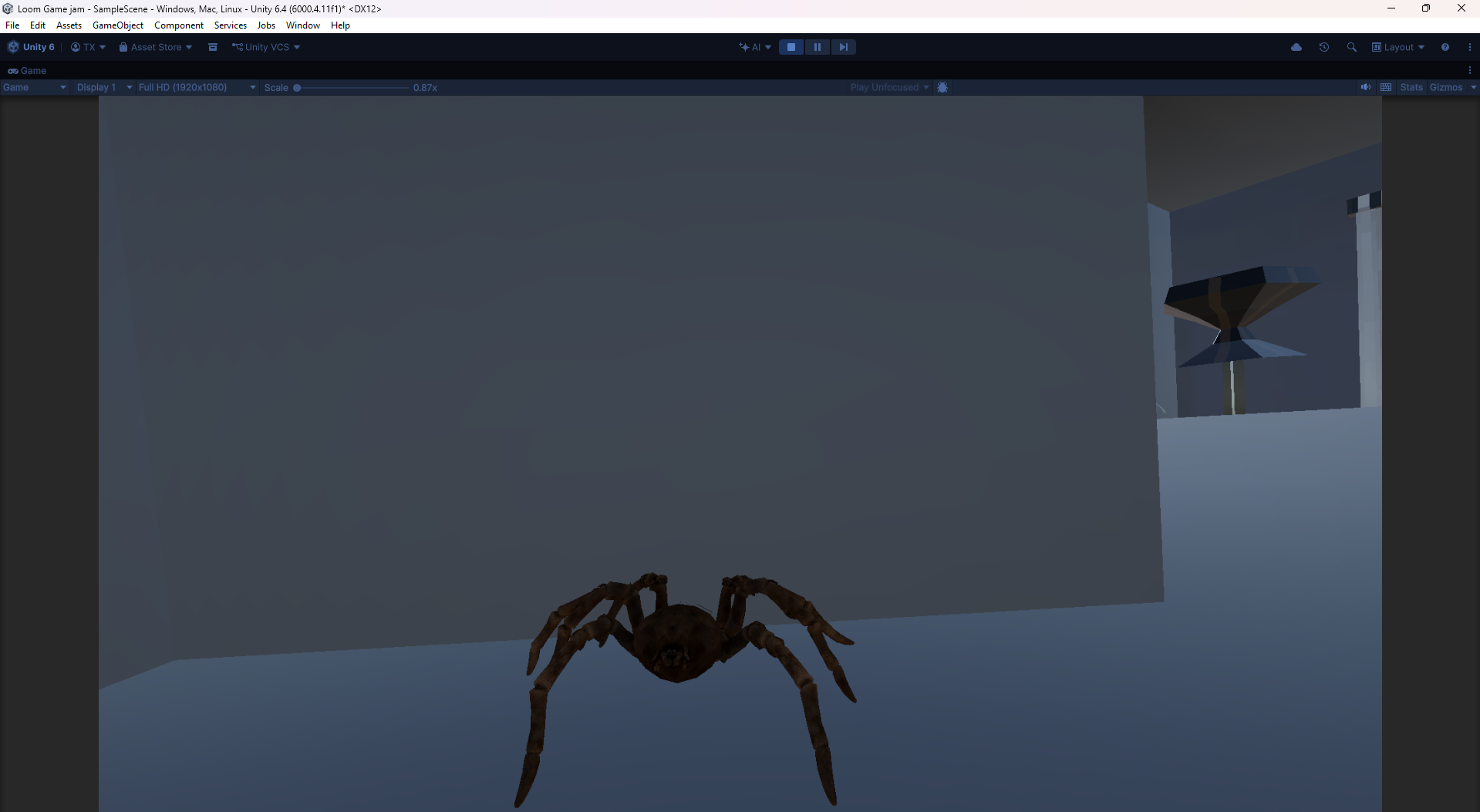
Scale-Restricted Crevice
Narrow baseboard gaps where predator spider cannot fit, giving player respite.
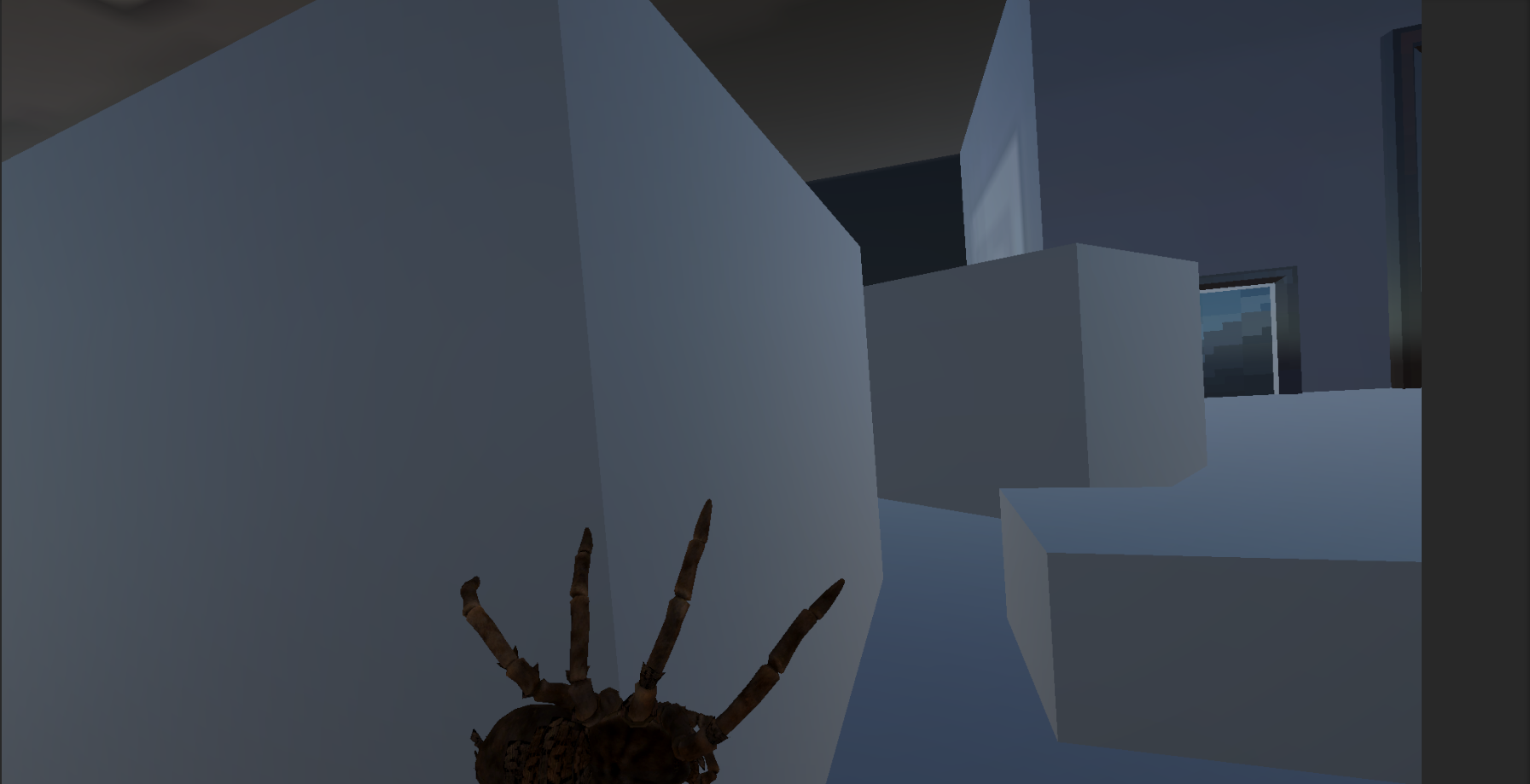
High-Elevation Web 04
Ceiling-corner anchor testing player mastery of upside-down 3D locomotion.
Intended Player Flow
The level layout directly underpins the psychological progression from initial disorientation to spatial mastery and tense survival execution.
Spatial Routing Support
The room geometry is intentionally non-linear. Players are never funnelled into dead ends without an alternative vertical escape vector (chair leg, wall seam, or baseboard crevice), ensuring that fleeing an approaching enemy feels like a tactical choice rather than an inevitable death.
Tension Modulation
High-tension build moments (where the player is stationary and vulnerable for several seconds) are immediately followed by release phases as the player scurries into dark crevices to scout their next trajectory.
Web Placement & Design Rationale
The 4 web locations were strategically anchored to balance tutorial onboarding, spatial expansion, risk exposure, and mastery of 3D spider movement.
Core Mechanic Onboarding & Low-Risk Anchor
Positioned near the initial spawn point beneath low furniture. This node teaches the player the fundamental interact-and-hold construction mechanic in an enclosed, low-threat space outside the enemy's starting patrol route.
Spatial Expansion & Vertical Surface Climbing
Anchored halfway up a wooden bookshelf or chair back. This requires the player to leave ground shelter, ascend vertical wooden surfaces, and orient themselves in 3D space, expanding their mental map of the room.
Active Patrol Interference & Timing Dilemma
Placed adjacent to the primary enemy spider patrol loop. Attempting this build without monitoring the predator's footsteps will trigger an immediate chase or result in the completed web being quickly torn down.
Climax Execution Under Countdown Urgency
Located in a high corner intersection requiring complex multi-wall climbing. By the time players reach this anchor, the global countdown is low, forcing a high-stakes execution sprint to seal the win condition.
Enemy AI & Player Pressure
Instead of acting as a generic combat foe that depletes player health bars, the enemy spider functions as an objective-denial mechanic. It transforms passive room navigation into an active tactical puzzle.
How the Enemy Changes Player Decision-Making
1. Spatial Route Alterations
When the predator is audible in the central floor area, the player is forced to take longer, elevated wall-climbing routes, trading precious countdown seconds for physical safety.
2. Build Window Commitment
Because building a web requires remaining stationary for several seconds, players must wait for the predator to turn a distant corner before initiating construction.
3. Defend vs Abandon Decisions
When the enemy approaches a completed web, the player faces a choice: create a distraction by intentionally breaking cover to lure the predator away, or retreat and rebuild later.
4. Audio-Driven Situational Awareness
Spatial 3D audio cues (skittering legs, venomous clicks) communicate predator proximity through headphones, allowing blind situational tracking from behind furniture.
From Blockout to Final Environment
The transition from greybox prototype to final playable space was guided by rigorous playtesting to solve navigation choke points, clarify climbable surfaces, and enhance atmospheric readability.
Greybox Primitive Blockout
Basic box colliders placed to establish macro room proportions. Tested spider surface normal raycasting on simple 90-degree angular edges and evaluated base walking speeds.
Spatial Routing & AI Playtesting
Refined furniture placements into distinct plateaus and valleys. Injected the enemy spider patrol waypoints and iterated on web node placement to ensure no spot was unreachable or permanently camped.
Final PSX Art & Lighting Polish
Integrated low-poly assets with pixelated textures and affine vertex jitter shaders. Added subtle bioluminescent web highlights to preserve visual navigation in low-light conditions.
Grayscale Composition & Readability Studies
Analyzing environmental composition through a strict level-design lens: focal points, silhouette separation, leading architectural lines, and lighting value contrast.
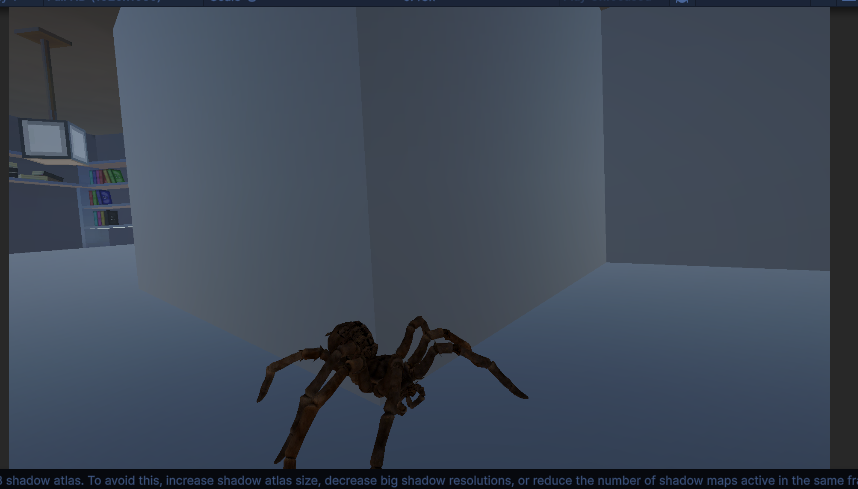
1. Silhouette Separation
Light background wallpaper values contrast against dark foreground wooden framing, making traversable structural seams immediately recognizable even at PSX low-resolution rendering.
2. Leading Lines & Guides
Vertical wooden grooves and furniture edges act as natural architectural leading lines, unconsciously guiding player gaze towards high-ground safety plateaus.
3. Occlusion & Claustrophobia
Dark ambient shadows beneath baseboards provide psychological reassurance of concealment, balanced against restricted field-of-view that prevents long-range enemy tracking.
The Core Gameplay Loop
How the global countdown timer, 4-web objective, enemy spider AI, and 3D level layout synthesize into a continuous survival loop.
Key Design Decisions & Rationale
Core creative decisions were intentionally selected to maximize tension, enforce scope discipline for a game jam, and deliver an unforgettable micro-scale perspective.
Why 4 Web Locations?
Four was calculated as the ideal metric within the game-jam scope: exactly enough to require four distinct spatial migrations across all room quadrants, without bloating round duration into repetitive backtracking.
Why an Explicit Global Timer?
Without a timer, stealth players would wait indefinitely in safe crevices for the enemy to wander far away. The ticking clock introduces essential friction, forcing players to take calculated risks and sprint through danger zones.
Why an Enemy Spider (Predator AI)?
Rather than environmental hazards (falling objects, hazards), an active predator creates dynamic, unpredictable encounters. Endowing it with the ability to destroy webs turns completed objectives into vulnerable assets that must be defended or timed strategically.
Why a Domestic Human House Setting?
Domestic human houses are universally familiar. By inverting the scale to micro-proportions, mundane items like table legs, bookshelves, and floor sockets become monumental architecture, evoking uncanny psychological scale without requiring complex fantasy lore.
Design & Technical Iterations
A transparent breakdown of critical mechanics iterated during playtesting to solve orientation issues, pacing balance, and enemy fairness.
Game Design Takeaways & What I Learned
Designing Around a Singular Clear Objective
A focused, unambiguous win condition (build 4 webs) keeps player cognitive load manageable even under intense time pressure and spatial complexity.
Using Environmental Scale to Create Organic Tension
Scale inversion is a powerful design tool. Everyday mundane objects become monolithic architectural obstacles that evoke visceral vulnerability without relying on cheap jump scares.
Designing Enemy AI Around Objective Denial
Giving AI the ability to attack player progress rather than solely player health creates richer strategic choices (distraction, sacrifice, timing) compared to basic attrition.
Connecting Level Design with Gameplay Systems
Level design cannot exist in a vacuum; vertical wall-climbing mechanics only feel rewarding when the environment provides deliberate architectural ledges, seams, and vantage points.
Balancing Stylized Readability Under Retro Constraints
Working with PSX-style low-resolution rendering demands deliberate value contrast, lighting hierarchy, and particle cues to ensure crucial interactables remain readable.
Rapid Playtest-Driven Iteration in Game Jams
Observing fresh players uncover blind spots, disorientation, and pacing bottlenecks is the fastest way to refine mechanics and prune unnecessary complexity within tight deadlines.
“LOOM demonstrates my ability to design engaging gameplay systems, construct atmospheric 3D levels, craft player-focused mechanics, and rapidly iterate on balance. It exemplifies my passion for working at the intersection of Game Design, Level Design, and Unity C# Gameplay Implementation.”